This blog and all its content has now moved to:
I will be closing this site down soon.
12 February 2015

19 October 2012
iSpot going mobile
 |
| The iSpot app (preview of the forthcoming upgrade) |
- iSpot itself
- The iSpot app (Android only at present, and currently in a beta stage, next upgrade due soon)
- Some background to the app development, from Will Woods:
- Summary of the iSpot app project on Will's blog
- A recent presentation on the app project
- A more detailed paper outlining the app development process
- The iSpot identification keys website, optimised for mobile use
Credits: the development of the iSpot app has been led by Will Woods and Richard Greenwood, of the Institute of Educational Technology at The Open University, with input from other members of the iSpot team, and valuable feedback from people who have tested the app in its early stages. The iSpot keys project has been led by Jon Rosewell, of The Faculty of Mathematics, Computing and Technology at The Open University.
24 February 2012
Extreme entomology at The Hollies
Having travelled to Shrewsbury last weekend to speak at the excellent Darwin Festival, organised by Shropshire Wildlife Trust and partners, I took the opportunity to do some extreme entomology. Okay, so The Hollies (next door to The Stiperstones, near Shrewsbury) is a bit higher than where I live, 350 metres as opposed to 100 m, but the altitude can't be said to be extreme. And although a cold, gloves-on February day might not be the usual choice for bug-hunting - the temperature records claim it was 7-8 °C, but with a biting wind it felt a good deal colder - that wasn't really extreme either, although it did make it hard to keep the beating tray steady. No, the extreme thing here was the trees I was searching for signs of insect life: a range of ancient Holly trees, some believed to be about 400 years old.

The Holly trees at The Hollies are an extraordinary range of shapes. Many are individual isolated trees that have been sculpted by wind and time into gnarled shapes that stretch and lean. There is precious little shelter to be had, either for the trees themselves, or any insects that might live in or on them, or indeed for the visiting entomologist. This must be one of the few Holly populations anywhere in Britain where the Holly Leaf-miner fly (Phytomyza ilicis) struggles to gain a foothold - I found just a few mines on one of the slightly less exposed trees.
But a lot of insects clearly do make their home here, as testified by the peppering of beetle exit holes in the trunks and limbs of the trees. And in fact the first insect to fall out of a Holly and onto my beating tray was the Lesser Thorn-tipped Longhorn Beetle (Pogonocherus hispidus). Larvae of this small (5mm) but attractive beetle develop in the small branches of a range of trees including Holly. Do have a look at these two great close-ups by John Hallmén on Flickr.
An hour or so of beating and grubbing around the trunks of the the trees produced a small list of other species:


The Holly trees at The Hollies are an extraordinary range of shapes. Many are individual isolated trees that have been sculpted by wind and time into gnarled shapes that stretch and lean. There is precious little shelter to be had, either for the trees themselves, or any insects that might live in or on them, or indeed for the visiting entomologist. This must be one of the few Holly populations anywhere in Britain where the Holly Leaf-miner fly (Phytomyza ilicis) struggles to gain a foothold - I found just a few mines on one of the slightly less exposed trees.
 |
| Pogonocherus hispidus on Holly bark at The Hollies |
An hour or so of beating and grubbing around the trunks of the the trees produced a small list of other species:
- Holly Speckle fungus, Trochila ilicina (a tiny fungus that only grows on dead Holly leaves)
- Lesser Thorn-tipped Longhorn Beetle, Pogonocherus hispidus
- a fly, Sylvicola cinctus
- Holly Leaf-miner fly, Phytomyza ilicis
- a flower bug, Anthocoris nemoralis
- a flower bug, Anthocoris nemorum
- Common Rough Woodlouse, Porcellio scaber
- Walnut Orb-weaver spider, Nuctenea umbratica
A modest list, but not bad for a very cold February afternoon, especially as all but two (Porcellio scaber and Anthocoris nemorum) of these invertebrates are new records for the Stiperstones area, according to the useful list compiled by Pete Boardman in 2010. I find it comforting that these many of these species have probably been happily living at The Hollies for many generations, over the centuries since the current hollies started growing.

The Hollies is a Shropshire Wildlife Trust reserve and SSSI, so thankfully its special character has been recognised and is being looked after. It's a shame that so many of the hollies have had to be fenced off, making it look rather like a tree zoo - presumably this is to prevent the trees being damaged by grazing stock. But the ancient hollies still work their magic, redolent of centuries of human interaction with the landscape. There's more about the history of The Hollies on Sara Bellis's blog, where she comments that in the past small boys would have been sent up the trees to collect the higher, less prickly leaves, as livestock feed. Since I was accompanied on my visit by a small boy in the shape of Kitenet jnr it's a shame I didn't think to put him to gainful employment for once ...
23 February 2012
Links for Oxfordshire recorders' day
[These links were originally compiled for a workshop in Oxfordshire in Feb 2012,
but may be of interest more widely.]
but may be of interest more widely.]
These are links to the various sites looked at during the online resources workshop at the Oxfordshire recorders' day, organised by TVERC on 25 February 2012. Quite a few of these have appeared in the blog before (e.g. citizen science, online identification), but they're all useful sites so no harm in repeating them.
Photos for identifying wildlife
Following discussion of the pros and cons of using digital photos for wildlife identification we spent some time exploring iSpot (you will be unsurprised to hear!), and what the site does to encourage proper documentation of photo-records and their identification. We also looked in on the iSpot identification keys.
Online recording
Next up was online recording, focusing on Indicia and Birdtrack. Like iSpot, Indicia is one of the projects from OPAL, and it provides a toolkit for adding online recording to an existing website. There are an increasing number of effective recording systems being set up with Indicia, including for the British Dragonfly Society and the BBC's version of the UK Ladybird Survey.
Birdtrack has been around for a while now, developed by the British Trust for Ornithology and partners, and it really is a superb way of making bird records useful both to you as recorder, and to the conservation organisations that can make use of your data. I've only recently started adding my bird records to the site (I'm not much of a birder, so it's not been a great loss to them!), and am really impressed with the way that Birdtrack handles a range of different types of recording, and provides excellent feedback.
Twitter, Facebook, Google+, blogs: time well-spent, or time, well, just spent?
We looked at just a few examples here including:
 |
| The Square Metre at TQ 78286 18846 |
- Mark Avery's genius for stimulating debate and making us think about conservation, farming and more
- Hagbourne Wildlife, a good example of a local area-based wildlife blog
- The Square Metre at TQ 78286 18846, my favourite biological recording blog ever
- Botanical Society of the British Isles on Facebook - a good example of how this should be done, regular updates, informative and entertaining
As for Twitter, just leap in and have a go. I'm @kitenet if you want to follow me. I haven't found how to make the most of Google+ yet, but I'm on there too.
Other resources
Finally, a mixed bag of other stuff:
- lots of mapping links on my Kitenet website - grid refs, gazetteers, GIS and other gadgets
- Nature Societies Online at the Natural History Museum - you'll be amazed how many wildlife-related groups there are in your county
- Biodiversity Heritage Library - great library of mostly older natural history and biodiversity science publications, mostly quite old, not only available as good quality scans but also searchable
- Instant Wild, a well-designed and fun citizen science project that asks you to identify mammals caught on camera from around the world - addictive and useful
Spot spotted, or not spotted?
The spot in question is Lempke's Gold Spot, a rather lovely moth named after the Dutch lepidopterist, B.J. Lempke, who I believe was the first to discover this species in Europe (it had long been known in the USA). In Britain it's mostly found in the northern half of the country, but there are a few records for the south.
Earlier today, Roy Leverton (author of the excellent Enjoying Moths) contacted me, in my capacity as Berkshire county moth recorder, regarding a potential Berkshire record of Lempke's Gold Spot. This was published in a note by R.F. Bretherton, in the Entomologist's Record for 1966 (available via the Biodiversity Heritage Library). In the note Bretherton refers to discovering that a specimen from his garden in Cumnor Hill, near Oxford, in 1940 had turned out to be Lempke's Gold Spot, a species that had only recently been recognised as European at the time of the note.
 |
| © Jim Vargo at Moth Photographers Group via EoL |
I had no record for Lempke's Gold Spot on the Berkshire database, and the species is not included in Brian Baker's book on the county's moths either, so this could have constituted a new species, the 638th, for the county list - always an enticing prospect! However, the question arises why Baker did not include the record in his book; many of Bretherton's records were included, and Bretherton's moth collection went to Reading Museum on his death, the museum for which Baker was natural history curator for many years, and retained an active interest in after his retirement.
So I am left wondering whether Baker saw the Lempke's Gold Spot record or specimen and rejected it, or whether it didn't get into his book because he was simply unaware of it. The 'normal' Gold Spot is very similar to Lempke's Gold Spot (sometimes needing dissection to distinguish the two), and in Bretherton's article he states that the specimen was of a worn individual, so there is an element of doubt.
What all this adds up to is that, unfortunately, the verdict has to be "not proven", and the idea of Lempke's Gold Spot being a Berkshire moth must remain an intriguing possibility. If only we could travel back to 1940 and have a look round at the habitats then available.
15 February 2012
Wildlife, citizens, science - Darwin Festival Feb 2012
Here are some links to do with citizen science and (mostly) wildlife recording, compiled to support a 'Café Science' event I'm presenting at the Darwin Festival in Shrewsbury, 17 February 2012.
Citizen Science (CS) projects, entirely online:
Citizen Science (CS) projects, entirely online:
- Herbaria at Home - museums and BSBI in an effective partnership to recruit help with digitising data from plant specimens (UK)
- Cornell bird identification - innovative project to get people to 'train' an online identification system (USA)
- WhaleFM - help categorise whale songs (international)
- Instant Wild - help identify mammals recorded on-camera (international)
- Zooniverse - collection of astronomical CS projects (universal)
- Mappiness - uses apps to get people to record how happy they are at particular times, intends to look at whether being out in green space improves happiness [of course it does!], among other aims (UK)
Real-world projects with clever online elements:
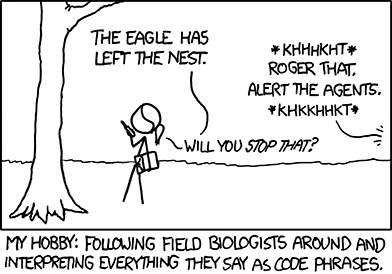 |
| Thanks to XKCD |
- Evolution Megalab from The Open University - main project has finished but you can still use and contribute to the website
- Nature's Calendar - you can contribute records of wildlife seasonal change, and also explore the records already online via some ingenious interactive maps (UK)
- OPAL surveys - well-designed environmental surveys with online data entry and analysis (UK)
- Your Wild Life - fun projects looking at wildlife (some of it at micro-organism level) in our homes and on our bodies - armpit biodiversity anyone? (USA)
CS record-breakers:
- Audubon Christmas Bird Count - apparently the oldest CS project in the world, continuous run since 1900
- RSPB Big Garden Birdwatch - apparently the biggest CS project in the world, with over 600,000 participants counting over 10 million birds in 2011
Wildlife survey CS projects mentioned in the talk:
- Darwin Guide - excellent general guide to wildlife recording from the National Biodiversity Network
- Butterfly Conservation surveys
- UK Butterfly Monitoring Scheme
- BSBI Loddon Lily Survey plus axiophytes and other projects
- BTO/JNCC/RSPB Breeding Birds Survey
- Ancient Tree Hunt
- Wildflowers Count
- British Waterways Wildlife Survey (plus critique from Jeremy Biggs)
Learning and skills:
- The botanical skills pyramid and FISCs
- Biological recording courses at Birmingham University - currently under threat of closure but hopefully can be re-introduced to a new habitat
- Field Studies Council
- OPAL iSpot from The Open University - help with wildlife identification from a range of very knowledgeable people
Other:
- Wildlife recorders: bingo conservationists? - not sure why this is in the BBC news this week, but it gives some wildlife recorders a chance to put their point of view, which can't be bad
- Lots more links on my Delicious pages
10 November 2011
Ragwort: what a fantastic plant for bees
Ragwort was in the news again earlier this year. I got interviewed on local radio about its value for moths (not a very rewarding experience, since the presenter seemed unable to get past his amusement at the idea of anyone actually being interested in moths). And environment minister Richard Benyon attracted a bit of attention with some ill-conceived Facebook comments about his hatred of Ragwort. Shortly after that episode, I happened upon this clump of Ragwort in full flower in the middle of one of my local SSSIs:

How many bees can you see on the flowers?

There were at least 50, which I've carefully highlighted in the second version of this photo, and they were having a fine old time necking nectar and perusing pollen:


Good sense on Ragwort is available from:

How many bees can you see on the flowers?

There were at least 50, which I've carefully highlighted in the second version of this photo, and they were having a fine old time necking nectar and perusing pollen:

On this occasion I didn't capture any to check the species; there were several involved, but I'm pretty sure that many of them were the solitary ground-nesting bee Lasioglossum calceatum (this one, with its long antennae, looks like a male):

Now, Ragwort can cause problems, being toxic to grazing mammals when consumed in large quantities, and where it poses a genuine risk to these animals it needs to be controlled. But in areas where grazing animals aren't an issue, Ragwort provides a valuable resource for many, many insects, including at least 30 insects and 14 fungi that are entirely dependent on the plant, plus the huge numbers of insects that visit the flowers for pollen and nectar, as shown above.
The controversy over the rights and wrongs of ragwort has raged for years now, and the claims for its harmful effects have often been widely exaggerated. There's plenty of good information about Ragwort available nowadays, not least in DEFRA's own Code of Conduct, so there's not really any excuse for continuing to demonise the plant. Like most entomologists, I remain pleased to see Ragwort in all non-grazing-mammal contexts, and hope to see many more plants covered in the buzzing of contented bees, flies, beetles and butterflies - the sheer exuberance of the bees in the photos above were one of my year's wildlife highlights.
Good sense on Ragwort is available from:
- Buglife
- Ragwort Facts website
- Butterfly Conservation (Scotland) factsheet (pdf download)
- Ragwort hysteria blog
- DEFRA Code of Conduct (pdf download)
synonymy
This blog used to be called "sweepnet", a title I was never happy with. Having had a good long break from even attempting to be a blogger, I'm going for a fresh start using another title that I'm not entirely happy with, but irregardless of that am giving it a try. Let's have a prolonged intake of breath for ...
Various hilarious puns on the subject of sucking suggest themselves, but we're all going to resist, aren't we.
pooter
Various hilarious puns on the subject of sucking suggest themselves, but we're all going to resist, aren't we.
4 April 2011
Putting wildlife on the map
 Last week I had the pleasure of teaching my first course for the fantastic Field Studies Council, at their Epping Forest centre. The day seemed to go well, and for me it was great to be out talking about wildlife-watching among the venerable old trees of the Forest.
I've added some of the materials from the course to a new biological recording section of my website, including information on recording, tips for photography and using keys, suggested surveys to try out, links to further resources and some field exercise sheets (downloadable). As ever, feedback welcome to improve what's there and fill in any gaps I've missed.
While reading up for the course I went back to the late Oliver Gilbert's very enjoyable book The Lichen Hunters. Despite not being any sort of lichenologist myself I loved reading about the exploits of Dr Gilbert and his colleagues in tracking down unusual lichens in a range of habitats, from pristine rocks high in the Cairngorms to the 'ancient tarmac' of abandoned WWII airfields. Finding lichens in mountainous habitats requires impressive feats of physical endurance - anyone want to start a campaign for lichen-hunting as an olympic sport?
The book contains one of my favourite biological recording quotes, capturing some of the emotions that come from close contact with wildlife and wild places:
“You go to look for lichens and find in addition familiarity, beauty, companionship, laughter and the warmth of friends.”
30 January 2011
New MapMate guidance
Running the MapMate biological recording database on Windows Vista and Windows 7 caused quite a few problems at first. Things seem to have been sorted out now, and if you run the latest version of MapMate (currently 2.4.0) on Windows 7 you should not encounter any difficulty.
Please let me have any feedback you may have from using the new document - does it make sense to you? Do the recommendations match what has worked for you?
4 March 2010
Information sources for invertebrate conservation
 The following resources were compiled for the training course on insect conservation that I led for BBOWT in March 2010. Course participants may also like to join the free mailing list for the Buckinghamshire Invertebrate Group.
Books
- Dennis, R.L.H. 2010. A resource-based habitat view for conservation – butterflies in the British landscape. Wiley-Blackwell, Chichester. [A densely technical read, but full of insight into the ways in which butterflies interact with their environment.]
- Fry, R., and Lonsdale, D. 1991. Habitat conservation for insects – a neglected green issue. Amateur Entomologists’ Society. [Contains lots of good information, but not as easy to use as Kirby’s book, and currently out of print.]
- Kirby, P. 2001. Habitat management for Invertebrates – a practical handbook. RSPB, Sandy. [If you only want one book on invertebrate conservation, make sure it is this one!]
- Thomas, J., and Lewington, R. 2010. The butterflies of Britain and Ireland (second edition). British Wildlife Publishing, Gillingham. [A fully revised edition of this classic book, with excellent summaries of the latest research into butterflies and their habitats.]
- Alexander, K., Butler, J., and Green, T. 2006. The value of different tree and shrub species to wildlife. British Wildlife 18: 18–28.
- Brooks, S.J. 1993. Joint Committee for the Conservation of British Invertebrates: Guidelines for invertebrate site surveys. British Wildlife 4: 283–286. [Also reprinted as AES Leaflet 38, Site survey guidelines, see http://is.gd/9HcbG].
- Key, R.S. 2000. Bare ground and the conservation of invertebrates. British Wildlife 11: 183–191.
The Amateur Entomologists' Society has an overview of insect conservation and guidance for insect-friendly gardening.
Buglife, the Invertebrate Conservation Trust, has some excellent resources on its website, including online summaries of its report on Managing priority habitats for invertebrates.
See also Buglife’s perspective on Ragwort and its control, and the series of farm habitat leaflets.
Butterfly Conservation has a habitat advice page with lots of downloadable leaflets on particular topics. Many of their other reports can also be downloaded.
The British Dragonfly Society has an online version of its Managing habitats for dragonflies leaflet; also on its website are “Management Fact Files” for the rarer species (look for the “MFF” links).
The Code for insect collecting is available from Invertebrate Link, and some of their other publications are hosted by the AES.
Natural England makes a range of reports and leaflets available, including:
• Organising surveys to determine site quality for invertebrates [short report]
• Grazing Heathland: A guide to impact assessment for insects and reptiles [excellent, although lengthy, review of the factors that should be taken into account before implementing a grazing regime]
• The butterfly handbook: general advice note on mitigating the impacts of roads on butterflies [report]
• Help save the Bumblebee ... get more buzz from your garden [leaflet]
• A review of the invertebrates associated with lowland calcareous grassland
• A review of seepage invertebrates in England
• Brownfield: red data. The values artificial habitats have for uncommon invertebrates
• Surveying terrestrial and freshwater invertebrates for conservation evaluation [technical report, includes description of ISIS system for assessing invertebrate assemblages]
Some of the papers in the Journal of Insect Conservation are freely available online, as are some in Insect Conservation and Diversity.
Conservation statuses for invertebrate species
Information on conservation statuses is dispersed and confusing, but here are the main sources. The nearest thing there is to a complete listing of all species statuses, including invertebrates, is to be found in the JNCC “Conservation Designations Spreadsheet”, a large file (last updated on 23 November 2009).
This includes species listings for BAP priorities, Red Data Books, Nationally Scarce, legally protected and some others. It needs using with care, as the various statuses have been applied at different times (some are now out-of-date) and using varying criteria. The major omission is national statuses for moths, which have never been formally published by JNCC, despite being widely used for many years. The best source for these is: Waring, P., Townsend, M., and Lewington, R. 2009. Field guide to the moths of Great Britain and Ireland. British Wildlife Publishing, Gillingham.
JNCC have very recently published a revised Butterfly Red List for Great Britain, which is not yet incorporated into the above spreadsheet.
Many of the statuses in the above spreadsheet were originally published in the series of Reviews that JNCC have published. These generally include a good summary of what was known about the distribution and ecology of the rarer species at the time (but some are now rather out-of-date). The older, hard-copy reviews are listed; the latest ones can be downloaded.
The British Dragonfly Society has further information on dragonfly and damselfly statuses, including regional priorities.
29 January 2010
Identifying invertebrates: downloadable keys
The previous post listed some identification keys that run online, as more-or-less interactive websites. This post includes some sites that have keys you can download (usually as pdf documents) and print out. See also my bookmarks on delicious.
Various groups
Some excellent materials, many produced by Brian Eversham, are available on the website for The Wildlife Trust for Bedfordshire, Cambridgeshire, Northamptonshire and Peterborough [link updated at October 2012]. These include keys to insect orders, grasshoppers and bush-crickets, water bugs, ants, beetle families, longhorn beetles and soldier beetles (plus other non-insect groups). NB that most of these are tailored to the Bedfordshire area, and do not necessarily include all UK species (the exception being the soldier-beetle one by Dr Mike Fitton, which does have all species).
Lepidoptera
Various resources, including an identification guide to grass moths (Pyralidae: Crambinae) compiled by Nick Asher, can be downloaded from the Berkshire Moth Group.
Hymenoptera
Some keys to selected groups of bees and ants are available from BWARS.
Diptera
Dipterists Forum has produced some really good downloadable keyes, some of which are available only to DF members; these include a very well-illustrated key to Diptera families, a key to Scathophagidae (dung-flies and allies), both of these by Stuart Ball, and a version of Alan Stubbs key to hoverfly tribes illustrated with photos by Stuart Ball - Dipterists Forum is worth joining just for these, let alone all the other benefits!
Available to anyone is the set of draft keys to craneflies, by Alan Stubbs, and keys to stilt and stalk flies, by Darwyn Sumner.
Coleoptera
The recently established Beetle News has included keys to various small groups of beetles in its first few editions, and they can be downloaded from the Amateur Entomologists' Society.
Field Studies Council
This listing from the FSC includes many of their published keys, available to purchase, but also some older papers that are free to download, including Unwin's key to Diptera families, and the now slightly out-of-date key to slugs by Cameron, Eversham and Jackson.
Various groups
Some excellent materials, many produced by Brian Eversham, are available on the website for The Wildlife Trust for Bedfordshire, Cambridgeshire, Northamptonshire and Peterborough [link updated at October 2012]. These include keys to insect orders, grasshoppers and bush-crickets, water bugs, ants, beetle families, longhorn beetles and soldier beetles (plus other non-insect groups). NB that most of these are tailored to the Bedfordshire area, and do not necessarily include all UK species (the exception being the soldier-beetle one by Dr Mike Fitton, which does have all species).
Lepidoptera
Various resources, including an identification guide to grass moths (Pyralidae: Crambinae) compiled by Nick Asher, can be downloaded from the Berkshire Moth Group.
Hymenoptera
Some keys to selected groups of bees and ants are available from BWARS.
Diptera
Dipterists Forum has produced some really good downloadable keyes, some of which are available only to DF members; these include a very well-illustrated key to Diptera families, a key to Scathophagidae (dung-flies and allies), both of these by Stuart Ball, and a version of Alan Stubbs key to hoverfly tribes illustrated with photos by Stuart Ball - Dipterists Forum is worth joining just for these, let alone all the other benefits!
Available to anyone is the set of draft keys to craneflies, by Alan Stubbs, and keys to stilt and stalk flies, by Darwyn Sumner.
Coleoptera
The recently established Beetle News has included keys to various small groups of beetles in its first few editions, and they can be downloaded from the Amateur Entomologists' Society.
Field Studies Council
This listing from the FSC includes many of their published keys, available to purchase, but also some older papers that are free to download, including Unwin's key to Diptera families, and the now slightly out-of-date key to slugs by Cameron, Eversham and Jackson.
Identifying invertebrates: online keys
 On Saturday 30 January, Roger Hawkins and I are running a workshop for the BENHS on using keys for insect identification. We'll mostly be working with published hard-copy keys, but we'll include some online keys as well. Below are some examples for various invertebrate groups.
I must admit that I don't yet make much use of online keys. This is partly because I'm fortunate in having a good range of printed keys available to me, and I'm sure it's also partly a case of 'sticking with what I know' rather than spending time learning the online ones (all keys require time spent on them to get familiar with their particular approach). However, I think there are still some problems with online keys, from the practical one of having to have a computer within easy view of your specimen or microscope, to more intrinsic issues about the ease of flicking through a book to compare different sections, as opposed to having to switch between different windows on a computer.
However, online keys are likely to become more widespread and will no doubt get better as time goes on, just as printed ones have (and continue to do so), and no doubt the two will be seen as complementary rather than an either/or choice.
See below for some online keys to try out. For a longer list (including plants and other groups as well as invertebrates) see my bookmarks on delicious, and let me know if there are any other good keys out there, or any thoughts you have on using online keys. A post on downloadable keys will follow.
Various groups
The most comprehensive set of online keys that I am aware of is the DELTA Intkey system. This requires you to download some software onto your computer, after which you can either download various individual keys, or run them from the web.
At the moment there is quite a wide range of keys available within this system, for various taxonomic groups (not just invertebrates) and different parts of the world, but for UK insect purposes they include:
Orders of insects, families of Coleoptera, families of Diptera, genera of Ephemeroptera, families of Hemiptera, families of Hymenoptera, families of Lepidoptera, genera of butterflies, genera of Geometridae, genera of Noctuidae, species of Phyllonorycter, species of Odonata, genera of Orthoptera, families of Trichoptera.These are multi-access keys so that you can answer the set of questions in any sequence, and need only answer the ones you're confident of - the system will endeavour to give you a best match of one or more names for your specimen. I've made most use of the family keys for Coleoptera and Diptera, but I have to admit they've not proved as helpful as I hoped, and I still tend to return to paper-based single-access (dichotomous) keys for backup. But it is always good to have additional keys available for comparison, and no doubt if I used them more I'd get more used to their idiosyncrasies and perhaps find them more helpful.
There are some draft online keys available on iSpot (part of OPAL), including a simple 'key to minibeasts' - this part of iSpot is still under development, and there'll be more to come.
Coleoptera
The Watford Coleoptera Group (click on "ID aids") are making a range of identification aids available, some in the form of keys, some as notes on particular species or groups of species.
Hymenoptera
[added on 10 February 2010]
The Natural History Museum provides a very useful key to bumblebees.
Diptera
These online keys to various families of Diptera are managed by Paul Beuk, who also runs the excellent Diptera.info. You may need to register on Diptera.info to get full access to the keys. Some of these keys are online versions of existing printed keys, others are new (e.g. includes the best key I'm aware of for genus Sylvicola in family Anisopodidae).
Not a key, but some very helpful support for keys is provided by the Anatomical Atlas of Flies, from CSIRO in Australia. This is a truly excellent web implementation of a morphology diagram and glossary of names for parts of flies, using detailed close-ups of real insect specimens. But it needs a good broadband connection to work at any speed!
Mark van Veen's Faunist is a Dutch site with keys to various families of Diptera, plus Odonata, Orthoptera and sea-shells. The latter three are in Dutch only, but most of the Diptera keys are in English. They are well-illustrated and easy to use, and I think cover most of the British species in the families included. Plenty of information about the species is given (but remember that this refers to the fauna in Holland, which will include additional species and different habitats/behaviours compared to the UK).
Some of these keys to robber-flies (Asilidae) by Fritz Geller-Grimm are applicable to the UK (others cover various parts of the world).
For those flies with larvae that produce leaf-mines (largely Agromyzidae, plus a few Anthomyiidae etc.) there are keys based on the foodplant on the excellent UK Fly Mines site.
Lepidoptera
Similarly, for leaf-mines of Lepidoptera try Barry Dickerson's online key, on the British Leafminers website. This is largely based on volumes 1 and 2 of "The Moths and Butterflies of Great Britain and Ireland", but with some additions and revisions. A very useful resource (but be aware of all the non-lepidopterous insects that also make leaf-mines, most of which are listed, but not keyed, elsewhere on the site).
Butterfly Conservation/Moths Count provide a simple key to day-flying moths.
Odonata
There is a good identification key to Irish dragonflies and damselflies, but it covers males only, and not all UK species are included.
Mollusca
The Conchological Society provide some online keys and other identification notes for various groups of snails and slugs.
Arachnida
This German website has a key to European spider families.
28 January 2010
OpenLearn - free courses from the Open University
[... mutters usual apology about lack of blogging for ages ...]
I've been delving in to the huge range of OpenLearn courses that the Open University makes available for anyone to try for free - that is, for no money whatsoever! There's quite a range of topics available, at various levels. They're done on-line, and you don't get any points or qualifications from doing them, but they provide an excellent way of getting an idea of what OU study is like, as well as being a fantastic source of information.
You can browse from the main subject areas, or see the full list of courses. Here are a few that caught my eye from the perspective of wildlife, conservation and computing:
Science and nature
Computers
I've been delving in to the huge range of OpenLearn courses that the Open University makes available for anyone to try for free - that is, for no money whatsoever! There's quite a range of topics available, at various levels. They're done on-line, and you don't get any points or qualifications from doing them, but they provide an excellent way of getting an idea of what OU study is like, as well as being a fantastic source of information.
You can browse from the main subject areas, or see the full list of courses. Here are a few that caught my eye from the perspective of wildlife, conservation and computing:
Science and nature
- Environment. Treading lightly on the Earth
- Finding information in science and nature
- Introducing the environment: ecology and ecosystems
- School activities: Evolutionary tree of mammals
- Studying mammals: a winning design
- Animals at the extremes: hibernation and torpor
Computers
- Living with the internet: keeping it safe
- Living with the Internet: online shopping
- An introduction to data and information [including intro to web browsers]
- ICTs in everyday life
13 October 2009
iSpot features moth new to Britain
 The OPAL iSpot project (see previous post) has had an exciting few days - a moth, found by six-year-old Katie Dobbins in Berkshire, was posted on iSpot, and has turned out to be a species not recorded in Britain before: Pryeria sinica, the Euonymus Leaf-notcher. This is native to Asia but has been found in a couple of places in the States since 2001.
Further details and more photos are on the Berkshire Moth Group website.
Thanks to Katie Dobbins for getting her dad to report the moth, and to Martin Honey of the Natural History Museum for his help in confirming its identity. Full details will be published as soon as possible, and the specimen is being passed on to the NHM.
This may well be just a one-off importation with plants or packaging, but it's emerged via the Back Garden Moths forum that the Euonymus Leaf-notcher was also seen in Spain last June, the only other record for Europe that we've heard of (so far!).
The Open University press office have made good use of the story and so far it's been picked up by the Express, Mail and Mirror. As usual the papers have their own perspective on this, and according to taste the moth is either the "UK's rarest moth" or the next major pest outbreak.
All good fun, and hopefully Katie has enjoyed her encounters with biodiversity and the media!
New atlas of bees, wasps and ants
 The latest atlas in the set being published by BWARS arrived a week or two ago:
Edwards, R., and Roy, H. (eds) 2009. Provisional atlas of aculeate Hymenoptera of Britain and Ireland Part 7. Wallingford: Biological Records Centre.
Part 7 of this atlas includes maps for a further 58 species, with brief species accounts summarising the distribution, ecology and conservation status. Following the BWARS plan, part 7 contains a mix of ants, wasps and bees, including nine of the small (and hard to identify) parasitic jewel wasps in genus Chrysis, seven of the solitary wasps in genus Crossocerus, a range of solitary bees and six bumblebees (genus Bombus).
The latter group includes an account of Bombus cullumanus, last recorded in Britain in 1941, in Berkshire, and now considered extinct following recent surveys of all the sites from which it was previously known. By contrast, the map for Bombus hypnorum shows how far this species has spread since it colonised Britain in 2001.
There is a useful summary of the problems of distinguishing workers of Bombus terrestris from those of Bombus lucorum (queens and males can be separated relatively easily, although for queens the situation is becoming more difficult as colonies of the continental, white-tailed, race of Bombus terrestris have been imported for commercial use); and of the status of Bombus lucorum itself, which has been shown to be an aggregate of three very similar species: B. lucorum sensu stricto, B. magnus and B. cryptarum.
The dot maps in part 7 show the most recent records as black dots for the period 1970 to 2007 (or so it says on page 9, but I think at least some of the maps include records after 2007 - certainly that for Bombus hypnorum does). While this maintains consistency with the maps in the previous parts of the atlas, it does not enable more recent changes in distribution to be shown. For example, it would have been good to see the recent expansion of range in species such as the parasitic bee Sphecodes niger shown more clearly on the maps.
One reason for producing atlases, and one of the reasons why mambers of BWARS work so hard to collate the records, is to monitor changes in species and look out for any worrying declines, and in part 7 there several examples of just this. For instance, the closely related solitary bees Andrena rosae and A. stragulata have not previously been listed as scarce or declining, but these maps show that there is cause for concern with few recent records.
The BWARS data for these species (but not the species accounts) can be seen on the NBN Gateway - for example, here is the map for Specodes niger.
10 October 2009
iSpot - helping people learn about wildlife
iSpot was launched last summer: "iSpot is the place to learn more about wildlife and to share your interest with a friendly community. Take a look at the latest spots, start your own album of observations, join a group and get help identifying what you have seen."
iSpot has been developed by the Open University as part of the Open Air Laboratories project (OPAL), with funding from the Big Lottery Fund. I've been part of the team working on it for the last year or so.
Here's an introduction to what iSpot is all about:
So far we have over 1,000 registered users on the site, including a healthy mix of beginners and more experienced naturalists, all busy helping each other identify what they've seen. One thing we're trying to encourage on the site is for people to explain why a species is that particular species, not just give its name. Of course, not all species can be identified from photos or descriptions, and the site allows this to be shown clearly where necessary.
Several national and local recording schemes have representatives active on the site, and they are being 'badged' with a logo next to their user name so that every time they are active on the site a link is given back to their society's website. If you're involved with a recording scheme or society and would like to find out more about this please do contact iSpot.
iSpot has been developed by the Open University as part of the Open Air Laboratories project (OPAL), with funding from the Big Lottery Fund. I've been part of the team working on it for the last year or so.
Here's an introduction to what iSpot is all about:
So far we have over 1,000 registered users on the site, including a healthy mix of beginners and more experienced naturalists, all busy helping each other identify what they've seen. One thing we're trying to encourage on the site is for people to explain why a species is that particular species, not just give its name. Of course, not all species can be identified from photos or descriptions, and the site allows this to be shown clearly where necessary.
Several national and local recording schemes have representatives active on the site, and they are being 'badged' with a logo next to their user name so that every time they are active on the site a link is given back to their society's website. If you're involved with a recording scheme or society and would like to find out more about this please do contact iSpot.
9 August 2009
MapMate: new user queries available
For MapMate users, I've added a few new queries to my MapMate resources page (see the SQL for user queries heading on that page):
- Information on creating queries that combine synonyms into the latest version of the name
- Query to update the date in a block of records
- Query to export data from MapMate in the format required to send it to the NBN Gateway (thanks to Graham French for help with this one)
6 June 2009
more moths and media
The Moths and Media talk (see below and below) gets another outing on Monday 8 June, 7,45pm, for Wycombe Wildlife Group - all welcome if you're within reach of High Wycombe, Buckinghamshire. Details are here.
19 May 2009
links from Moths and the Media talk
Here are the links to many of the websites referred to in the "Moths and the Media" talk I gave in Newbury on 19 May 2009, for Butterfly Conservation and BBOWT, and again for Moths Count at the South Wales Moth Recorders’ Gathering, September 2009.
Many of the links, including most of the 'serious' mothing identification sites and online resources for moth recorders, have already been listed in my previous post on this subject and aren't repeated here. The ones that are new:
Additional mothing sites
Online mapping and grid references
Moth-related blogs (a small and fairly random selection from among many)
Moth miscellany
Many of the links, including most of the 'serious' mothing identification sites and online resources for moth recorders, have already been listed in my previous post on this subject and aren't repeated here. The ones that are new:
Additional mothing sites
- Berkshire Moth Group
- Butterfly Conservation moth pages (including key to day-flying moths)
- BC Upper Thames Branch moth sightings (up-to-date news of what's been seen in Berks, Bucks and Oxon)
- Netherlands Microlepidoptera (Dutch text, excellent photos)
- Moths aren't scary they rock! (moth supporters on Facebook)
Online mapping and grid references
- Where's the path - OS maps and Google aerial photos side-by-side (this site has recently moved URL)
- Grab a grid reference - excellent innovation from Keith Balmer for Bedfordshire Natural History Society, displays grid reference squares at various resolutions over Google maps and aerials (works throughout UK)
Moth-related blogs (a small and fairly random selection from among many)
- Garden Critters (moths and other wildlife from Tilehurst, Berkshire)
- Martin's Moths (i.e. Martin Wainwright of the Guardian)
- Calderdale Moths, Butterflies and Dragonflies
- Thornton Moth Man (complete with great illustration of a moth-er in action)
- St Margaret's at Cliffe Photo Diary (various wildlife including moths)
- North American Moths Backyard Inventory (interesting comparison with mothing in the UK)
Moth miscellany
- Rachel talks to a moth (Big Brother 2008)
- Recycled wool anti-moth sachets (from Instructables website)
- Make your own moths from felt
- Dr Who scenes created by moths (actually a well-reported story from Daily Mail)
- Vampire moths (this story got widely and rather sensationally reported, but there is some interesting science behind it)
- The Moth Generator - using magnetic moths to produce electricity (fun but not terribly practical concept!)
- Moths mimicking spiders
- Grizzly Bears feed on moths
Subscribe to:
Posts (Atom)